Cosmetic development capabilities
Formulation development

Formulation is a series of trade-offs, not a moment of inspiration. Every choice — the emulsifier, the thickener, the preservative, the active level — moves cost, texture, stability and the claim you are allowed to make. Good development makes those trade-offs visible early, while they are still cheap to change.

Approach
The brief comes before the bench.
We ask for six things: the consumer and their skin concern, the price point and channel, the claim that has to appear on the front, the format and pack, the market, and the volume you can realistically sell. Without those, a formulator is guessing, and guessing is expensive.
From the brief we propose two or three directions at bench scale, each with an indicative cost at target volume, a stability risk assessment and a list of the tests it will need. You choose with the numbers in front of you.
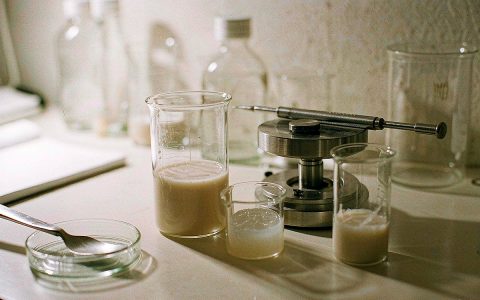
Then comes the part most projects underestimate: the pilot. A formula that behaves on a 500g bench batch can separate, weep or change viscosity at 500kg with a different mixer and a longer cooling ramp.
Systems
What we develop, and what each one costs you in testing.
| System | Typical products | Development notes | Testing load |
|---|---|---|---|
| Oil-in-water emulsion | Creams, lotions, body butters | The workhorse. Emulsifier system drives both texture and cost; high internal phase systems are less forgiving at scale | Stability, compatibility, challenge test, micro |
| Water-in-oil | Rich creams, SPF carriers | Excellent for barrier occlusivity; harder to stabilise with natural emulsifiers | Stability, compatibility, challenge test, SPF if claimed |
| Gel and serum | Serums, gels, cleansers | Carbomer or xanthan systems; electrolyte tolerance decides how many actives you can load | Stability, compatibility, challenge test |
| Anhydrous | Balms, cleansing butters, lip products | No preservative burden, but oxidation and crystallisation are the risks | Stability, compatibility, oxidation |
| Surfactant | Cleansers, shampoos, body wash | Mildness is a function of surfactant blend and pH, not marketing language | Stability, challenge test, pH, foam |
| Powder and waterless | Powder cleansers, solid formats | Attractive on packaging weight and EPR; dispersibility and dosing are the practical constraints | Stability, micro, re-dispersion |
Testing is usually 15–25% of first-run development cost. Skipping it does not remove the cost; it moves it to a recall, a retailer rejection or a reformulation after the artwork is printed.
Actives
2026 ingredient briefs, and the honest constraints.
Ceramides, ectoin, cholesterol, fatty acids
Physiological lipid ratios matter more than the headline percentage. Ectoin is stable and well tolerated, which makes it a reliable story — provided the level is meaningful and the claim describes what was measured.
Retinaldehyde, HPR, encapsulated retinol
Efficacy is not the constraint; stability and irritation are. Encapsulation adds cost and a supplier documentation burden, and the claim must match the tested concentration.
Lab-grown squalane, fermentation actives
Purity and provenance are the selling points. Ask for the specification and the impurity profile, because your safety assessor will.
Lower irritation load, real hydration data
Usually less about a single hero ingredient and more about what you remove: drying alcohol, high fragrance load, aggressive acids. Efficacy evidence has to be generated, not borrowed.
Questions
Formulation, practically.
How long does formulation take?
Four to eight weeks for bench development and selection, then four to eight weeks of stability and compatibility work running in parallel with packaging. A first production run inside fourteen weeks is possible; inside eight is not, unless the formula already exists.
Can you match a competitor product?
We can match a format, a texture and a performance brief. We will not copy a protected formula, and we will tell you when a “dupe” brief is not achievable at the target cost — the honest answer is usually that the texture can be matched and the active level cannot.
Do you formulate natural or organic products?
Yes, with a caveat worth stating: natural emulsifiers and preservation systems are less robust, so testing has to be more thorough, not less. Certification bodies have their own standards, and we will only claim a certification the brand actually holds.
Who writes the INCI list and the warnings?
We prepare the ingredient declaration and conditions of use from the formula and the safety report, and the assessor signs them off. The label is then checked against the file before print.
Further reading
More on formulation and claims.
 Formulation
Formulating for perimenopause: what the brief has to say
A £2bn category with an unforgiving customer. Why a relabelled anti-ageing serum fails, and what a credible formulation brief contains.
15 September 2026 · 4 min read Compliance
Making cosmetic claims that survive scrutiny in the UK
What "clinically proven" actually requires, which claims need instrumental data, and the wording that quietly turns a cosmetic into a medicine.
10 November 2026 · 4 min read Cost and MOQ
What it really costs to develop a skincare product in the UK
A line-by-line budget, the retail maths that constrains it, and the four costs that appear after you have committed.
3 November 2026 · 4 min readNext step
Wherever you are based, start with a conversation — not a purchase order.
Tell us what you are building, where it needs to land and which suppliers you already have. We will come back with an honest view of feasibility, timings, indicative costs and the compliance route — usually within two working days.
info@vervylincosmetics.comWritten enquiries are answered by the founder, not a sales desk.
+971 50 648 9197Sunday to Thursday, 09:00–18:00 GST
Dubai, United Arab EmiratesUK meetings by appointment.